
How We Calculate the Volume of a House Move
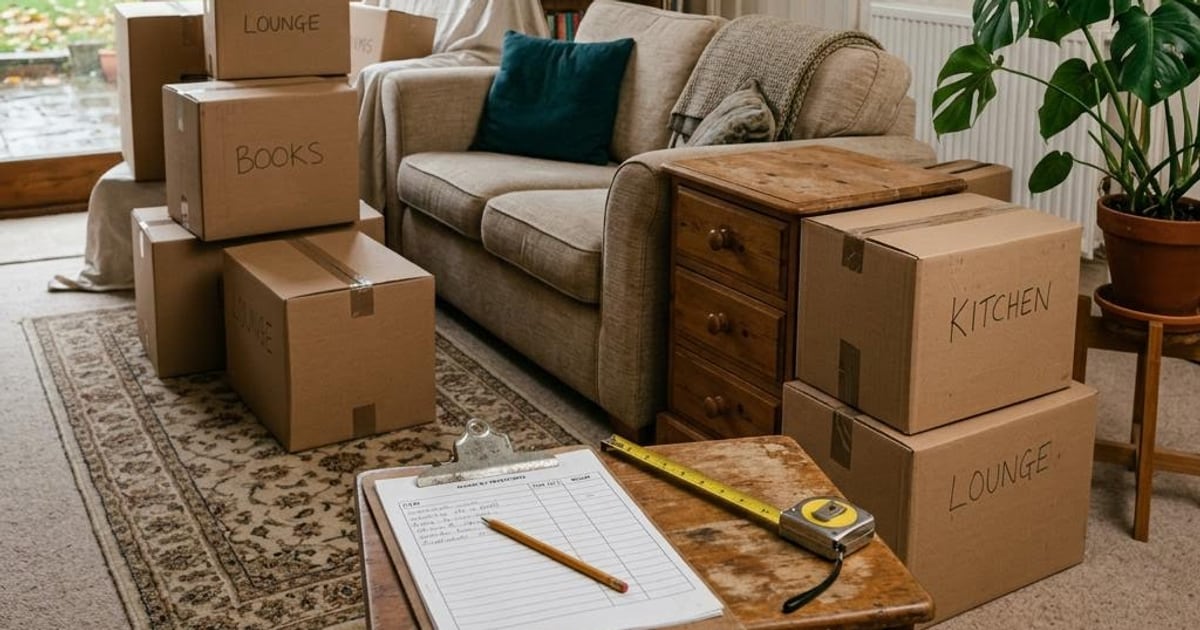
Removal companies calculate the volume of a house move by listing the furniture, appliances and boxes in each room, giving each one a typical size in cubic feet, and adding up the total, with space allowed for awkward shapes. That figure decides how big a van you need, how many people move it and how long the job takes. At Leaways Removals & Storage, the inventory you enter in our quote calculator does that job. It sits alongside access, distance and any packing or dismantling to set the crew, the vehicles and your price.
In October 2026 we moved a lovely couple from St Albans to Darlington. The inventory they booked fitted comfortably in one Luton van, and the day was planned around it.
When the crew arrived, the garden told a different story. There were 38 large plants, a set of garden furniture, a work table and a lot of garden tools, none of which had been mentioned. Plants are the awkward ones, because you can't stack them. Each pot needs its own patch of floor.
We keep at least one support vehicle on standby for days like this, so we called it straight away. The keys had to be handed over at 1pm, and our move coordinator came out with the support van himself. We left the property by 1:10pm. It was sorted, but it added stress and pressure to a day that should have been calm.
The lesson from that day: list the garden, the shed and the plants, not just the rooms. This guide shows how we turn your list into a volume, and how to make the list match the house.
Every move starts as a list and ends as a number
Movers in the UK still talk in cubic feet, even though most of us measure furniture in centimetres. One cubic metre is about 35.3 cubic feet, so a figure of 600 cubic feet is roughly 17 cubic metres.
The method is simple. Each common item has a typical volume, based on its size once it's wrapped and ready to load. Most estimators would recognise these rough figures:
- Three-seater sofa: about 50 cubic feet
- Double bed with mattress: about 40 to 50 cubic feet, less once the frame is taken apart
- Double wardrobe: about 40 to 50 cubic feet
- Fridge freezer: about 30 cubic feet
- Washing machine: about 12 to 15 cubic feet
- Chest of drawers: about 15 to 20 cubic feet
- Medium packing box: about 3 cubic feet
Add those up room by room and you have a raw total. An experienced eye then adjusts it. A sofa with fixed arms leaves dead space that boxes can't fill. A dining table with removable legs packs flat. A mattress stands on its edge. That's why two homes with the same furniture can load differently, and why the list matters more than the bedroom count.
One point catches people out: storage is measured in floor area, but vans are measured in volume. Storage through our partner facilities is priced by floor area, from 25 sq ft (about a studio's contents) to 200 sq ft (a 4+ bedroom home). A van is sold on how much it holds in three dimensions. Don't mix the two up when you're planning a move that includes storage.
Rooms have typical sizes, but your home has its own
Bedroom count is a starting point, not a measurement. As a rough industry guide, the contents of a typical home come out like this:
- Studio or one-bedroom flat: around 300 to 500 cubic feet
- Two-bedroom home: around 600 to 900 cubic feet
- Three-bedroom house: around 1,000 to 1,500 cubic feet
- Four-bedroom house: around 1,500 to 2,000 cubic feet
- Five bedrooms and up: often 2,000 cubic feet or more
Those ranges are wide for a reason. One three-bed semi in Harpenden might have fitted wardrobes, a small garden and a nearly empty loft. Another on the same street might have freestanding wardrobes, a home office, a piano and a garage you can't walk into. Same bedrooms, very different volume.
Vehicle sizes vary in the same way. The figures below are typical industry estimates, not the specification of any Leaways vehicle, and the exact numbers depend on the body:
| Vehicle | Load space (cubic feet) | Load space (cubic metres) | Approximate payload |
|---|---|---|---|
| Large panel van (long wheelbase) | about 350 to 500 | about 10 to 14 | about 1,000 to 1,400kg |
| Luton box van (3.5 tonnes) | about 550 to 700 | about 16 to 20 | about 800 to 1,200kg |
| 7.5-tonne removal lorry | about 1,000 to 1,400 | about 28 to 40 | about 2,000 to 3,000kg |
So when people ask "how big a van do I need?", work out your volume first, then match the vehicle to it.
There's a local twist here. The Luton van takes its name from our town. Its box body stretches over the cab, a design said to have started with Luton's straw-hat trade, where loads were bulky but light. That still matters today. A van can run out of weight before it runs out of space. Most Luton vans have a maximum authorised mass of 3,500kg, which is the limit for driving petrol and diesel vans on a standard car licence (GOV.UK, 2026). That 3,500kg includes the van itself, which is why the payload in the table is so much lower. A load heavy with books, tools or garden stone can reach that limit with floor space to spare. Weight belongs in the plan as well as cubic feet.
Boxes are where most estimates go wrong
Furniture is easy to count because you can see it. The contents of cupboards, drawers and shelves are not. Every one of those spaces turns into boxes on packing day, and boxes are where most inventories fall short.
A few rules of thumb help. A full bookcase often becomes four to six boxes. A kitchen usually takes more than people expect, because crockery, pans and food cupboards add up fast. As a rough guide, a one-bedroom flat might fill 20 to 30 boxes, a two-bed home 30 to 50, and a three-bed house 50 to 80. A keen cook, a collector or someone working from home will sit at the top of those ranges.
The quickest way to check your count is to open the doors. Stand in each room, open the cupboards and estimate how many boxes each shelf will fill. It takes a few minutes per room and it's far more accurate than a guess from the sofa.
If packing feels like too much, our packing service is available alongside a removal. As a guide, packing a one-bedroom flat takes two to three hours, and a three-bedroom house takes four to six. Either way, the boxes need to be in your inventory, because they take up space in the van whoever packs them.
The hidden volume lives behind doors you rarely open
Under-estimated moves almost always have the same culprits. They're the spaces you walk past every day without noticing what's in them.
- The loft. Lofts hold far more than people remember: suitcases, old baby kit, decorations, boxes from the last move. Our crews can't go into loft spaces for insurance reasons, but they will help from floor level. Bring the contents down to the landing before moving day and count them in.
- The under-stairs cupboard. It's small, but it's packed tight. Hoovers, mops, the ironing board and folding chairs all need space in the van.
- The garage and shed. Bikes, mowers, tool chests, ladders and storage crates are bulky and often awkward to stack. Petrol and other flammable items can't travel, so plan for those separately.
- The garden. We move plant pots, garden ornaments and garden furniture, so list them. Plants can't be stacked, and a set of patio chairs, a parasol base and a few large planters can fill a surprising amount of space.
- Bulky one-offs. Pianos, safes, gym equipment, American-style fridge freezers and large mirrors need their own line in the inventory. Tell us about anything unusually heavy, fragile or valuable before you book, so the crew arrives with the right kit.
Which?, the consumer group, gives the same advice for remote quotes: list your possessions as accurately as you can and don't forget the loft or garage (Which?, 2026).
Volume decides the van, the crew, the hours and the price
Once the volume is known, the rest of the plan follows from it. Bigger volume means more vehicle space, more trips up and down the stairs and more time on the clock.
In our quote calculator, your house move inventory comes in step two, alongside any dismantling, packing labour and materials. Step three covers crew size, parking distance and time slots. Together with the postcodes, property type, floor level and lift access from step one, those details set the vehicles and the crew. For larger homes, the plan may use more than one vehicle. We specialise in flats, bungalows and 1–2 bedroom homes, and our expanded fleet supports carefully planned 3–4 bedroom moves.
Time follows volume too. A local move generally takes four to eight hours, and where your home sits in that window depends largely on how much is going and how far it has to be carried. A ground-floor flat with parking outside is a very different day from a third-floor flat with no lift and a long walk to the van, even with the same contents. That's why every Luton removal is planned around stairs, lifts, parking and carry distance as well as volume.
Then there's price. Once you book from accurate details, your removal quote becomes a fixed price, with no hidden or extra moving-day charges. If the inventory changes, we'll explain any price adjustment before extra work is carried out wherever possible. An accurate list is what keeps the price you saw as the price you pay.
A better inventory takes twenty minutes, not a weekend
Whether a firm sends someone for a home survey or asks you to fill in a list, the result is only as good as what goes in. Work through the house in this order:
- Walk the house in order. Start at the top and work down, so you don't skip a room. Include the landing, hallway and any built-in storage.
- List furniture first, then boxes. Count the big items, then estimate boxes shelf by shelf.
- Go outside last. Shed, garage, garden and side return. If it's coming with you, it goes on the list.
- Note what's staying. If the wardrobe in the spare room is being sold with the house, leave it off. Telling us what isn't coming is as useful as telling us what is.
- Decide what to clear first. Reducing volume before you get a quote is the simplest way to cut the price. Our guide to decluttering before a move explains how. Our Tidy Tipping service can take away household furniture you no longer need.
- Compare like with like. If you're weighing up firms, check that each removal quote is built on a similar volume. Our guide to comparing removal quotes shows why that matters.
If part of the load is heading into storage, arranged with CCTV-monitored partners, list those items separately. They need their own space in the van and their own space at the other end.
We cover homes across Luton, Dunstable, Harpenden, Bedford and the surrounding towns. See our house and flat removals page for what's included. When your list is ready, the quote calculator takes less than two minutes and shows a personalised price based on the furniture and boxes you've listed.
Frequently asked questions
How many cubic feet is a two-bedroom house move?
As a rough guide, the contents of a two-bedroom home come to around 600 to 900 cubic feet. A full loft, garage or garden can push it higher. List your furniture and boxes room by room in the Leaways quote calculator, and the crew and vehicles are planned around your actual inventory.
How big a van do I need to move house?
Work out your volume first. Most Luton box vans hold around 550 to 700 cubic feet (about 16 to 20 cubic metres), and a 7.5-tonne lorry roughly 1,000 to 1,400 cubic feet (about 28 to 40 cubic metres). Leaways plans the vehicles from your inventory, access and distance, using more than one vehicle where a larger move needs it.
What do people forget to include in a removal inventory?
The most common gaps are loft boxes, the under-stairs cupboard, the shed, the garage, garden furniture and plants. Leaways crews can't go into lofts, so bring loft contents down to the landing before moving day and include them in your inventory.
What happens if I have more to move than I listed?
Extra items need extra space, time or crew. Leaways prices are fixed once booked from accurate move details. If the inventory changes, we'll explain any price adjustment before additional work is carried out wherever possible.
Planning a move?
Get a personalised calculator price from Leaways Removals & Storage, fixed and guaranteed once booked from accurate move details. We specialise in well-planned moves for flats and 1-2 bedroom homes across Bedfordshire, Hertfordshire and Buckinghamshire.
Get a free quote